
Why This Matters Now
A Los Angeles illustrator opens Instagram and sees an image that looks uncomfortably familiar—same characters, same mood, even the same line work. Only this time, the caption reads: “Made with AI – Stable Diffusion.”
Across town, a small Pasadena startup is pitching investors on a new design tool “powered by Stable Diffusion and Midjourney.” They scraped together open‑source models, hooked them into a slick interface, and are now selling subscriptions to marketing teams and content creators.
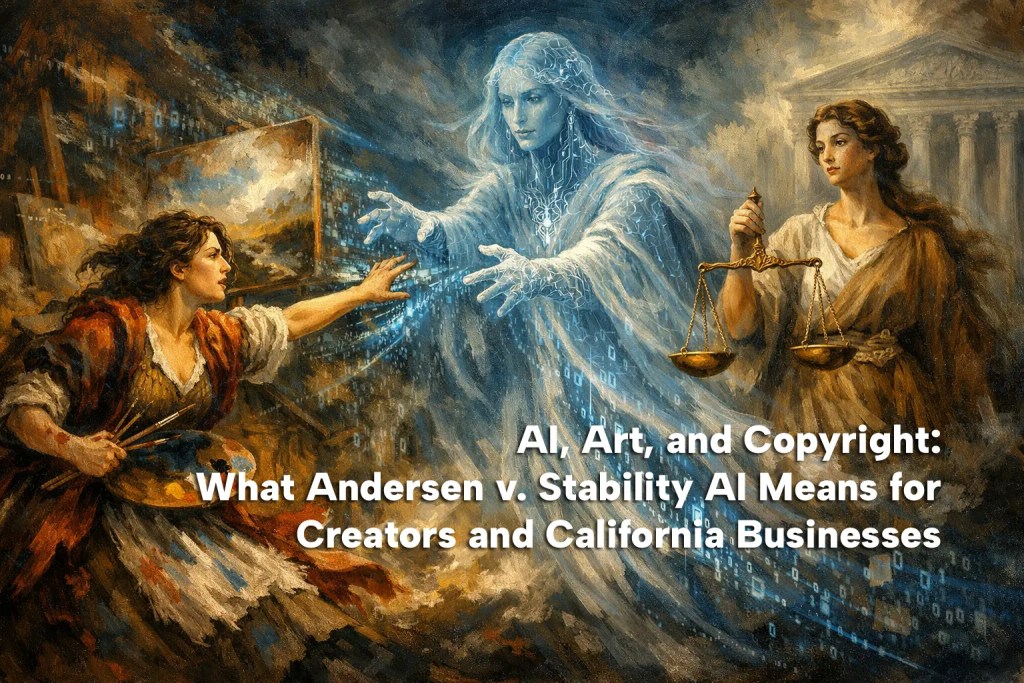
Both the illustrator and the startup are standing in the shadow of the same case: Andersen v. Stability AI, a class‑action lawsuit in the Northern District of California that is testing how U.S. copyright law applies to AI image generators that were trained on billions of images scraped from the internet.
In August 2024, the federal judge overseeing the case refused to throw out the artists’ core copyright claims at an early stage, allowing them to move forward into discovery. That doesn’t decide who will win. But it does mean courts are treating artist complaints about AI training and style mimicry as serious, live issues—not science fiction.
This blog is a primer, not a case brief. It explains, in plain English:
- What Andersen v. Stability AI is about,
- The big copyright questions it raises, and
- What it means for artists, creators, and California businesses experimenting with AI.
What This Means in California
A California Test Case on AI and Art
In Andersen v. Stability AI, a group of visual artists—led by cartoonist Sarah Andersen—sued several AI companies in the Northern District of California:
- Stability AI – maker of the Stable Diffusion image model,
- Midjourney – the popular text‑to‑image system running on Discord,
- DeviantArt – which launched an AI tool called DreamUp, and
- Later, Runway AI – whose products incorporate Stable Diffusion.
The artists allege that:
- Their works were scraped from the web into massive datasets such as LAION‑5B, a 5‑billion‑image collection used to train image‑generation models.
- These models can now:
- Reproduce images that are very similar to training images when carefully prompted, and
- Generate new images “in the style of” specific artists, often by simply typing the artist’s name into the prompt.
They argue that this is not just “inspiration”—it is copyright infringement on a mass scale.
Because the case is being heard in a California federal court that frequently handles technology and IP disputes, its rulings will influence how other courts and lawmakers think about training AI on copyrighted content.
The Andersen Case
Who sued whom?
A group of visual artists, including Sarah Andersen, Kelly McKernan, and Karla Ortiz, plus several others, filed a class action in federal court against:
- Stability AI (maker of Stable Diffusion),
- Midjourney,
- DeviantArt (DreamUp), and
- Later, Runway AI.
What do they claim?
- Their artwork was scraped from the internet and ingested into massive LAION training datasets without their permission.
- Stable Diffusion and related tools were trained on those datasets and now:
- Can recreate or closely approximate some of the training images, and
- Can generate new images in the distinctive styles of individual artists when users simply type their names into prompts.
What has the judge decided so far?
- In October 2023, the court trimmed the case:
- It dismissed several state‑law claims and some copyright claims where works weren’t registered,
- But allowed direct infringement claims based on training Stable Diffusion on Andersen’s registered works to go forward.
- In a major order on August 12, 2024, the court:
- Denied motions to dismiss the artists’ core copyright claims, including:
- The theory that training on their images can be infringement, and
- The theory that the trained model itself may embody infringing material in a new, compressed form.
- This does not decide who wins; it simply means those key theories are strong enough to be tested with evidence in the next stages of the case.
- Denied motions to dismiss the artists’ core copyright claims, including:
4. Key Copyright Questions AI Raises (Using Andersen as the Example)
Generative AI is new, but the questions it raises are built on familiar copyright ideas. Andersen v. Stability AI just puts those questions in a modern, high‑stakes context.
Question 1: Is Training on Copyrighted Images Without Permission Infringement—or Fair Use?
To train tools like Stable Diffusion and Midjourney, developers used massive datasets (such as LAION‑5B) built from billions of images scraped off the internet. Many of those images were created by human artists.
- The artists in Andersen argue that:
- Copying their images into training datasets without consent is straightforward copyright infringement—no different from copying their work into a giant private library.
- The sheer scale (billions of images) just makes it mass infringement, not something categorically different.
- The AI companies respond that:
- Training is more like “learning patterns” from data than storing copies.
- The resulting model is a set of numerical weights, not a visible gallery of source images.
- They suggest this process should be analyzed under fair use principles, but courts haven’t ruled on that yet.
So far, the California court has not decided whether training is fair use. It has only said the artists’ argument—that unlicensed training on their images could be infringement—is strong enough to go forward for fuller factual development.
Question 2: Can the AI Model Itself Be an “Infringing Copy”?
One of the most important debates in Andersen is whether the trained AI model itself might count as an infringing copy or derivative work.
- The artists say:
- The model doesn’t just forget their images. It stores transformed representations of those works inside its parameters.
- In that sense, their art is “fixed” in a new medium: a compressed, numeric form that can be used to recreate similar images.
- The court has signaled:
- At this early stage, it’s plausible that a model trained on copyrighted works might embody some protectable expression in a new form.
- That’s enough for the artists to proceed toward discovery, where technical experts will unpack how the model actually behaves.
This doesn’t mean every AI model is infringing. It means courts are open to the idea that a model “built to a significant extent on copyrighted works” could raise more than just abstract, theoretical concerns.
Question 3: Who Is Responsible When AI Outputs Look Too Close to an Artist’s Work?
Another key issue is responsibility for what AI tools produce.
- Questions being tested in Andersen include:
- Direct liability for the company that built and distributed a model trained on unlicensed art.
- Induced or contributory liability if a company:
- Markets its system as able to mimic specific artists by name, or
- Knows its tool is producing outputs very close to existing, copyrighted works.
Again, the court hasn’t ruled on ultimate liability. It’s simply said that these theories are serious enough to warrant a full look at the facts, rather than being dismissed on day one.
What This Means for Artists and Creators
If you’re a visual artist, illustrator, comic creator, or designer, Andersen v. Stability AI should feel very close to home.
Courts Are Taking Artists’ Complaints Seriously
A federal judge in California has agreed that:
- Using copyrighted images in training datasets without permission can raise real infringement issues.
- The idea that a model might store transformed versions of those works—and be able to recreate similar images—is not just science fiction. It’s a legal question worth investigating.
This doesn’t guarantee a win for artists, but it does mean their concerns are being heard in court.
Registration Still Matters
One practical lesson from Andersen:
- Artists with registered copyrights are in a stronger position to bring claims and seek statutory damages and attorneys’ fees.
- If your work is important to your livelihood or brand, it’s worth considering copyright registration for key series or collections—not just posting online and hoping for the best.
Style vs. Specific Works
Copyright protects specific expressions, not “style” in the abstract. That means:
- No one owns “dark fantasy style” or “cute cartoon style” in general.
- But if a model is trained directly on your specific, copyrighted pieces and:
- Uses your name as a prompt, and
- Produces work that is close to identifiable pieces or clearly trades on your reputation,
that can raise clearer questions about infringement and even false endorsement.
Practical Next Thoughts for Creators
This blog isn’t legal advice, but as a primer, it’s worth thinking about:
- What work you’ve shared online and whether it’s part of your core portfolio or livelihood.
- Whether to register key works, especially signature projects or collections.
- How platforms, agencies, or publishers you work with address AI training in their contracts and terms of service (do they reserve AI training rights by default?).
What This Means for AI, Tech, and Other Businesses
If you’re a California startup, tech company, or business using AI imagery, Andersen is also your wake‑up call.
Training on “Whatever Is on the Internet” Carries Risk
Andersen spotlights the legal risk of building on:
- Massive scraped datasets (like LAION‑5B),
- Without clear licenses for the underlying works.
Relying on “everyone else is doing it” is not a legal defense. Courts are now openly exploring whether this kind of training is permissible—or whether it crosses the line into unlicensed exploitation of copyrighted content.
Marketing and Product Design Matter
How you talk about your product can be just as important as how it works:
- Promoting your tool as generating art “in the style of [famous artist]” or sharing lists of artists whose styles your model can mimic may create:
- Trademark‑style risks (false endorsement or association), and
- Stronger arguments that you are targeting specific artists and their goodwill.
Similarly:
- Boastful statements about your model being able to “recreate” training images can be used to support claims that the model embeds those works in a legally significant way.
Downstream Use and Integration Aren’t Invisible
Even if you’re not training your own models, you should think about:
- Where your AI tools come from (open‑source model? licensed? proprietary API?),
- What your contracts say about:
- Indemnification for IP claims,
- Restrictions (if any) on how you can use the tools, and
- How you label, disclose, and market AI‑generated content in your own products or services.
For many businesses, this is less about stopping AI use and more about managing risk with eyes open.
Who Should Be Paying Attention to This Case
You don’t need to read court opinions to be affected by them. Andersen v. Stability AI is especially relevant if you are:
- A visual artist, illustrator, comic creator, designer, or photographer who shares work online.
- A studio, agency, or production company using AI images in your creative pipeline or client projects.
- A California startup or tech company building, fine‑tuning, or integrating generative‑AI image tools into your offerings.
- A small or mid‑sized business using AI imagery in marketing, branding, or on your website, especially through third‑party services.
- A business owner or entrepreneur for whom intellectual property—your brand, content, or technology—is a key asset.
Let’s Talk—When You’re Ready
The law around AI and copyright is changing fast, and Andersen v. Stability AI is one of the cases shaping that change from a California courtroom. For many people, the hardest part isn’t the technology—it’s knowing what to do with this information in real life.
You don’t have to navigate it alone.
Yang Law Offices is a Southern California–based firm led by Attorney Elizabeth Yang, a multi‑disciplinary lawyer and entrepreneur with experience in Intellectual Property, Business Law, Family Law, and Estate Planning. Our team regularly works with:
- Creators and professionals whose work and reputation are central to their livelihood, and
- Businesses and startups that rely on technology and intellectual property to grow.
Whether you are:
- An artist worried your work may be in someone’s training dataset,
- A business already using AI tools and unsure what your risk is, or
- A founder building products that involve generative AI,
we can help you:
- Review how your work or your business might intersect with these emerging AI copyright issues,
- Understand what current cases like Andersen v. Stability AI do—and do not—decide yet, and
- Develop a practical, forward‑looking strategy tailored to your situation.
You don’t have to make big decisions today. But you can get clear, California‑focused advice so you’re not guessing.
Disclaimer
This blog is for general informational purposes only and does not constitute legal advice. Reading it does not create an attorney–client relationship with Yang Law Offices or any of its attorneys. Laws and court decisions discussed here may change, and how they apply depends on your specific facts. For guidance on your situation, please consult a licensed California attorney.
Sources
- Copyright Alliance – “Top Takeaways from Order in the Andersen v. Stability AI Copyright Case” (Aug. 29, 2024)
https://copyrightalliance.org/andersen-v-stability-ai-copyright-case/ - Columbia Undergraduate Law Review – “Original or Stolen? The Battle Between AI Image Generators and Visual Artists” (Andersen v. Stability AI overview, 2025)
https://www.culawreview.org/journal/original-or-stolen-the-battle-between-ai-image-generators-and-visual-artists - NYU Journal of Intellectual Property & Entertainment Law (JIPEL) – “Andersen v. Stability AI: The Landmark Case Unpacking the Copyright Risks of AI Image Generators” (Dec. 2, 2024)
https://jipel.law.nyu.edu/andersen-v-stability-ai-the-landmark-case-unpacking-the-copyright-risks-of-ai-image-generators/ - NYU JIPEL – Artificial Intelligence / Copyright category index (includes Andersen coverage and related AI–copyright posts)
https://jipel.law.nyu.edu/category/artificial-intelligence/ - NYU JIPEL – Copyright category index (context for broader copyright issues, including Andersen)
https://jipel.law.nyu.edu/category/copyright/