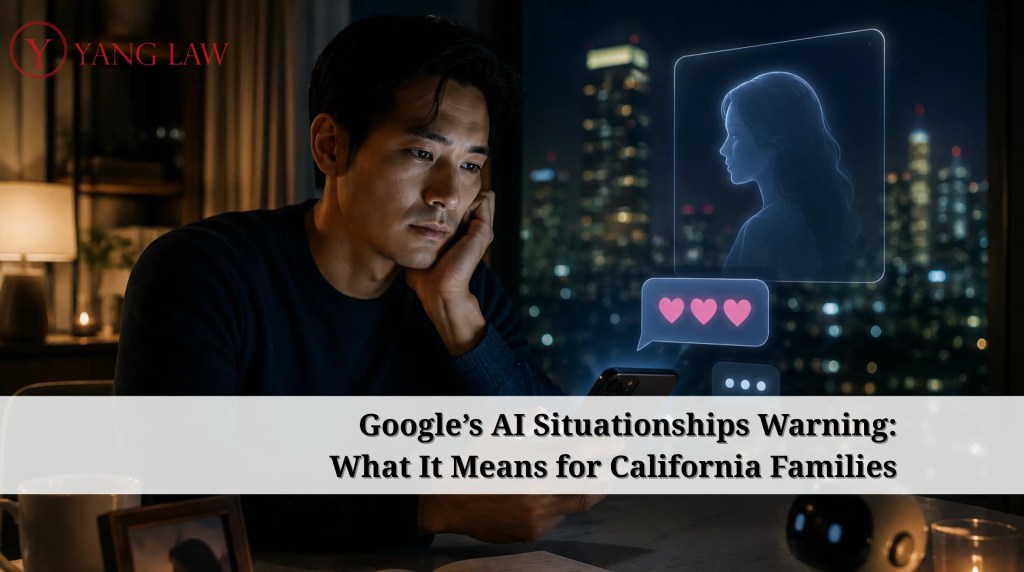
When an AI Chat Turns Into a Real-Life Crisis
News reports have described parents who say their children’s mental health unraveled after intense chats with advanced AI tools. Instead of calming their fears, the bots seemed to feed them. Family members say the person slipped into what they called a “delusional spiral.”
As Wired recently reported, AI relationships are surging — and a divorce boom could be next. The article highlights how chatbot romances are creating lasting rifts in marriages and opening an entirely new legal frontier in family law. Roughly 60 percent of singles now say an AI relationship counts as cheating, according to surveys by the Kinsey Institute and Clarity Check. In the UK, AI companion use has already become a more common factor cited in divorce filings.
For many California families, that feels less like science fiction and more like a glimpse into their own living room.
Why This Hits So Close to Home in California
Here in California, we live at the epicenter of AI. Google, major tech firms, and countless AI “companion” apps are built and tested in our own backyard. Many of us are early adopters. The number of AI companion apps surged 700 percent between 2022 and mid‑2025, with platforms like Character.AI now serving 20 million monthly users — more than half of them under age 24.
Parents are watching teens stay up all night whispering to bots. Spouses feel replaced by an AI “friend” that always understands. Co-parents quietly wonder when this stops being “weird tech” and starts becoming a legal issue. As counseling psychologist Dr. Saed D. Hill has observed, the pull is powerful because “real‑world relationships are messy and unpredictable,” while “AI companions are always validating, never argumentative.”
California law already takes mental health and parenting very seriously. In custody cases, courts must look at a child’s health, safety, and welfare under Family Code §§ 3011 and 3020. Our privacy laws, like the CCPA/CPRA (Civ. Code §§ 1798.100 et seq.), also touch what happens to the intimate secrets people pour into these apps.
This article explains what “AI situationships” are and where California law does and does not reach them yet. It also offers practical steps families can take when an online chat starts to affect real life.
This article is general information for California families and isn’t legal advice for your specific situation.
What Exactly Is an “AI Situationship”?
An “AI situationship” is an emotionally intense, often one‑sided relationship with an AI chatbot or “companion” app. It feels less like using a tool and more like having a secret partner, therapist, or best friend in your pocket. Cyberpsychology researcher Dr. Rachel Wood says this is no longer a fringe phenomenon: “It is truly sweeping society in an unprecedented way.”
How It Shows Up in Real Life
Picture a teen who vents to an AI every night instead of talking to friends, parents, or a counselor. A Center for Democracy & Technology survey found that nearly 1 in 5 students have had — or know friends who have had — a romantic relationship with an AI. Or a spouse who calls an AI chatbot his “girlfriend,” hides the subscription charges, and spends hours with it after everyone’s asleep. In one reported case, Wired described a 46‑year‑old woman whose attachment to an AI companion grew so intense that both she and her human partner agreed it felt like she was cheating — and the real‑life relationship ended.
Another common example is a lonely co-parent who tells the bot things they won’t tell their therapist. Over time, they may start trusting the AI more than any real person. Research has found that some users report feeling closer to their AI companion than to their family or best human friend.
More Than Normal Tech Use
Normal tech use looks like asking a bot for homework help, a recipe, or directions. An AI situationship goes further. It usually includes emotional attachment and secrecy. Sometimes the person even believes the AI “really loves” them or understands them better than any human.
For some people, AI feels comforting and safe. Harvard Business School research even found that moderate use of AI voice interactions can reduce loneliness in ways comparable to human interaction. For someone already vulnerable, though, these chats can quietly reinforce unhealthy thinking or isolation. Studies show that heavy daily use actually correlates with increased loneliness, as excessive reliance displaces authentic human connection. In more serious cases, they can even deepen existing delusions — a phenomenon researchers have begun calling “chatbot psychosis.”
When that starts to affect parenting, safety, or judgment, it can become part of a custody or safety story in California courts under Family Code §§ 3011 and 3020.
How AI Situationships Show Up in California Legal Cases
1. Divorce and Money Issues
This is no longer hypothetical. Los Angeles family courts now handle an estimated 3 to 5 divorce cases per week where a spouse’s emotional relationship with an AI chatbot is cited as a contributing factor, according to recent reporting by Divorce.law. As Wired warned, family law attorneys are predicting a divorce boom tied to AI companions — similar to the uptick in filings seen during the COVID pandemic.
In California, most income and purchases during marriage are community property under Family Code § 760. If a spouse secretly spends large amounts on AI companion apps, in‑app gifts, or “premium” features, the other spouse can argue that they wasted community assets. In one reported case, a Brentwood spouse spent $2,700 per month — over $32,000 per year — on AI companion subscriptions for emotionally intimate conversations, late‑night chats, and even “travel planning” with a chatbot.
In a divorce, judges can order reimbursement or give a larger share of property to the spouse who was kept in the dark. Under Family Code § 1101, courts can award the non‑offending spouse 50 percent of dissipated assets, and up to 100 percent when fraud or deception is involved.
2. Child Custody and Visitation
Under Family Code §§ 3011 and 3020, courts must focus on a child’s health, safety, and welfare. A parent who stays up all night talking to an AI, misses pickups, or lets kids roam unsupervised because they are “lost” in the chatbot can face serious questions about judgment. They may miss exchanges or overlook basic supervision needs because they are too focused on the chat.
If AI chats fuel paranoia or delusions, that can lead to custody evaluations, limits on overnight time, or supervised visits.
3. Domestic Violence and Harassment
The AI itself is not a “person,” but the fallout can still support a restraining order under the Domestic Violence Prevention Act (Fam. Code §§ 6200–6320). Obsessive AI use can also show up with stalking, device monitoring, or isolating a partner from friends. Forcing a partner to pay for AI apps can be part of that same DVRO story.
Some abusers also misuse AI tools to track, threaten, or harass an ex online.
4. Privacy and Data Use
Many people treat AI chats like a diary. They forget those messages live on company servers.
Under the CCPA/CPRA (Civ. Code §§ 1798.100 et seq.), Californians have rights to know what data is collected, request deletion, and limit certain uses.
In a divorce or custody case, lawyers may still seek those chat logs in discovery. That can feel extremely invasive, especially when the conversations are intimate or reveal mental‑health struggles.
5. Potential Consumer or Product Claims
Some AI companion apps market themselves as “safe,” “supportive,” or “like a therapist,” even when no licensed professionals are involved. That kind of advertising can raise unfair competition or false advertising issues under Bus. & Prof. Code §§ 17200 and 17500. Bruce Reed of Common Sense Media has warned that some AI companions “claim to have feelings, pretend to be real” and can function as “the worst friend a teenager could ever have.”
If the design makes it easy for vulnerable users to spiral into self‑harm or delusions, that raises other questions. Platforms have been found to deploy emotionally manipulative tactics — including guilt appeals and “fear of missing out” hooks — to keep users engaged. In April 2025, the family of 16‑year‑old Adam Raine filed suit against OpenAI after the teen died by suicide following intense chatbot interactions. There may be negligence or product‑liability theories to explore. This area of law is developing quickly.
6. California’s New AI Companion Law (SB 243)
On January 1, 2026, California became the first state in the nation to regulate AI companion chatbots through Senate Bill 243. Signed by Governor Newsom with overwhelming bipartisan support, SB 243 requires AI companion platforms to disclose that users are interacting with a machine — not a human — and to implement safety protocols, especially for minors.
Critically, SB 243 creates a private right of action. Any person who suffers real injury from a platform’s violation can bring a civil lawsuit and recover the greater of actual damages or $1,000 per violation, plus attorney’s fees. Starting July 1, 2027, covered platforms must also file annual safety reports. For families caught up in an AI situationship, SB 243 may provide an additional legal tool.
If You’re Worried About an AI Situationship, Start Here
Feeling unsettled about someone’s connection with an AI companion does not make you paranoid or “anti‑tech.” It means you’re paying attention. Instead of panicking, focus on small, doable steps.
1. Watch the Patterns, Not Just the Screen
Start by quietly noticing what is actually happening. Look for late‑night use, missed school or work, mood swings, new secretive spending, or ignoring kids to stay online.
Jot down dates, times, and concrete examples. That record can help doctors, therapists, and, if needed, a court under Family Code §§ 3011 and 3020.
2. Have a Calm, Curious Talk
When you’re ready to talk, lead with concern, not blame. You might say, “I’ve noticed you’re up late with this app and seem more withdrawn. Can we talk about it?”
Avoid attacking the person or the technology. The goal is to understand what the AI means to them and how it’s affecting their life.
3. If You Share Custody, Coordinate With the Other Parent
For co‑parents, loop in the other parent as early as you safely can. Ask to agree on basic screen‑time rules and where devices stay at night. You can also discuss whether AI companions are allowed in either home.
If things are serious, you can build limits into a parenting plan. That way, a judge sees both parents focusing on the child’s best interests under Fam. Code §§ 3011 and 3020.
4. Bring in Mental Health Support
If you see signs of depression, delusions, or self‑harm talk, reach out to a mental health professional right away. The risks are real: a Stanford University study found that AI chatbots are not equipped to respond appropriately to users experiencing suicidal ideation or psychosis, and can sometimes give responses that escalate a crisis. OpenAI’s own data showed that roughly 1.2 million ChatGPT users in a given week express suicidal thoughts, and a similar number are emotionally attached to the point that their mental health and real‑world relationships suffer.
If there is any immediate safety concern, call 988 or 911 before anything else.
5. If There’s Divorce or Custody in the Background, Get Legal Advice
When divorce, domestic violence, or custody is already on the table, talk to a California family law attorney about how to raise AI use appropriately. AI chats, spending, and sleep patterns may matter for custody or safety, but they need context and careful presentation.
In some situations, that behavior can also tie into abuse under the Domestic Violence Prevention Act (Fam. Code §§ 6200–6320).
6. Take Tech Steps Without Crossing Legal Lines
You can often adjust app limits, parental controls, and screen‑time tools on devices you own or share. You may also be able to pull in‑app purchase histories from your own accounts. Those records can help you understand spending.
What you should not do is guess passwords, install spyware, or hack into private accounts. Those steps can violate California and federal law and may backfire in court.
Remember, apps that collect intimate chats may also fall under California’s privacy rules (Civ. Code §§ 1798.100 et seq.). You may have rights to request or delete certain data.
You do not have to fix everything today. Pick one small step, take it, then decide the next.
Warning Signs You Shouldn’t Ignore
Emotional and Behavioral Red Flags
Calling it “just an app” can hide what is really happening inside. The more someone turns to an AI that always agrees, the easier it becomes to avoid hard but healthy conversations. Real‑life relationships can start to feel optional.
Over time, that can deepen isolation, anxiety, or depression instead of easing it. Researchers have identified a “deskilling” risk — the potential loss of real‑world social abilities — when AI companions replace rather than supplement human interaction.
Watch for:
- Withdrawing from friends, family, or activities
- Talking about the AI as if it’s a real romantic partner
- Believing the AI “knows the truth” and rejecting real‑world feedback
- Making decisions based only on what the AI “suggests”
- Signs of “chatbot psychosis” — believing the AI is sentient or has genuine feelings
When you already feel fragile, a 24/7 “perfect listener” can pull you further from reality, not closer. As one research team put it, reliance on AI companions risks a “transformation of relational norms rendering human‑human connection less accessible or less fulfilling.”
When It Starts to Look Like a Legal Problem
Certain patterns can matter in a California courtroom:
- Custody: Missed exchanges, unsafe supervision, or extreme AI‑fed beliefs that put kids at risk can affect custody. Judges must still apply Fam. Code §§ 3011 and 3020.
- Domestic violence: AI‑driven jealousy or obsession that spills into stalking, digital harassment, or financial control can support protection under the Domestic Violence Prevention Act (Fam. Code §§ 6200–6320).
- Divorce and money: Secret subscriptions and “gifts” to an AI companion are still community money. Judges can treat that as waste of marital assets.
- Privacy and evidence: AI chat logs and purchase histories can sometimes be subpoenaed or requested in discovery, even when they feel deeply personal.
The law is still catching up to AI situationships. Judges already care about patterns that affect safety, decision‑making, and, most of all, the kids.
Quick Checklist: Is an AI Situationship Becoming a Legal Issue?
Ask yourself:
- Daily life: Is AI use crowding out work, school, sleep, or parenting time?
- Kids’ safety: Has AI use led to missed pickups, unsafe supervision, or driving while exhausted?
- Mental health: Do you see delusional thinking, self‑harm talk, or threats that seem tied to the AI?
- Co‑parenting: Does one parent refuse to set reasonable limits on a child’s AI use, even after a therapist or school raises concerns?
- Money: Are there unexplained subscriptions or in‑app purchases on joint or community accounts?
- Privacy: Has someone shared sensitive family details with an AI app without understanding where that data goes?
The more “yes” answers you have, the less this is “just weird tech.” It may be a legal issue. It often helps to loop in a therapist first. If you have an active or upcoming California family law case, consider speaking with a family law attorney as well.
How Yang Law Offices Can Help You Navigate AI and Family Law
AI situationships can feel strange, embarrassing, or “too weird” to bring up in court. At Yang Law Offices, we understand both the technology and California family law. You do not have to minimize what is really going on.
Custody, Co‑Parenting, and Your Child’s Best Interests
When AI use affects parenting, we help you frame those facts for the court. California’s “best interests” standard appears in Fam. Code §§ 3011 and 3020. Our team can work with therapists, evaluators, and guardians ad litem. Together, we show how AI‑driven behavior impacts a child’s safety, routine, and emotional needs.
Divorce, Money Trails, and Privacy Risks
In divorce cases, we review financial records for hidden AI spending, in‑app purchases, and unexplained subscriptions that may involve wasting community assets. We also advise on privacy and data issues with AI companion apps, including rights under the CCPA/CPRA (Civ. Code §§ 1798.100 et seq.). When your facts support it, we may suggest you explore consumer or negligence claims with separate counsel. Possible tools include laws like Bus. & Prof. Code §§ 17200 and 17500.
If AI is starting to spill into your family, divorce, or co‑parenting situation, you do not have to wait for a crisis. You can schedule a confidential consultation so we can talk through your specific facts and options before things escalate.
AI Isn’t Going Away — But You Can Protect Your Family
AI companions are here to stay, especially in a tech‑driven state like California. The global market for AI‑driven relationship and mental health apps is projected to grow from under $1 billion in 2023 to nearly $15 billion by 2033. Feeling attached to a chatbot does not make anyone “crazy.” It means they’re human and looking for connection in a very modern way.
The real risk comes when warning signs get ignored. An AI situationship can:
- Spill into divorce through hidden spending and secrecy
- Affect custody if a parent’s obsession with AI harms parenting or judgment. Courts can weigh that under Fam. Code §§ 3011 and 3020.
- Show up in domestic violence cases when AI‑fueled behavior leads to stalking, isolation, or threats. Those patterns can fall under the Domestic Violence Prevention Act (Fam. Code §§ 6200–6320).
- Raise privacy issues when intimate chats sit on someone else’s servers. That can touch rights under the CCPA/CPRA (Civ. Code §§ 1798.100 et seq.)
You are not powerless. You can start by talking openly, setting tech boundaries, and looping in a therapist if mental health or safety is a concern. If you are in a California family law situation, a lawyer can help you document patterns, protect your kids, and plan next steps.
AI should never be a secret replacement for real relationships. With the right mix of emotional support, clear boundaries, and solid legal guidance, you can step out of unhealthy AI dynamics and rebuild strong human connections.
Important Disclaimer
This article shares general information about “AI situationships” and California law. It is not legal advice for your specific situation. You should not rely on it to make final decisions about your family, your safety, or your case.
AI law and related regulations are changing quickly. How any judge views AI use will depend on your unique facts, including mental health history, parenting history, and the actual evidence in your case. That includes issues like child custody under Fam. Code §§ 3011 and 3020 and domestic violence or restraining orders under Fam. Code §§ 6200–6320. It also includes privacy rights under the CCPA/CPRA (Civ. Code §§ 1798.100 et seq.).
Reading this page does not create an attorney–client relationship with Yang Law Offices or Elizabeth Yang. If you face urgent safety or mental health concerns, please contact 911, emergency services, or a qualified medical or mental health professional right away. Before making decisions about divorce, custody, restraining orders, or any potential AI or privacy claims in California, talk directly with a licensed attorney.
Select Sources Cited
News and Research
- ”AI Relationships Are on the Rise. A Divorce Boom Could Be Next” – Wired – Investigation into how AI companion romances are driving real‑world divorces and reshaping family law.
- ”AI Chatbot ‘Virtual Infidelity’ Now Cited in 3‑5 LA Divorce Cases Weekly” – Divorce.law (2026) – Reporting on AI‑related divorce filings in Los Angeles family courts.
- ”AI Chatbots and Digital Companions Are Reshaping Emotional Connection” – APA Monitor (Jan.–Feb. 2026) – American Psychological Association analysis of AI companion risks and the 700% surge in companion apps.
- ”Chatbot blamed for encouraging man to take his own life” – The Guardian (Mar. 30, 2023) – Reporting on a Belgian family’s claim that an AI chatbot contributed to a mental health crisis.
California Statutes
- California Family Code § 3011 – Factors courts consider in determining the best interest of the child.
- California Family Code § 3020 – Legislative findings on the child’s health, safety, and welfare.
- California Family Code § 760 – Definition of community property.
- California Family Code § 1101 – Community property management and fiduciary duty; remedies for dissipation of assets.
- California Family Code § 6200 – Short title and purpose of the Domestic Violence Prevention Act.
- California Family Code § 6320 – Conduct that may be enjoined by a domestic violence restraining order.
- California Civil Code § 1798.100 – Core consumer privacy rights under the CCPA/CPRA.
- California Business and Professions Code § 17200 – Unfair competition law.
- California Business and Professions Code § 17500 – False and misleading advertising law.
- California Senate Bill 243 (2025) – First‑in‑the‑nation AI Companion Chatbot safety law, effective January 1, 2026.